
- 20 Aug 2026
- 619 Views
- 8 minutes read
How Does Cryptocurrency Mining Work? A Beginner's Guide to Crypto Mining
If you've ever wondered how new Bitcoin enters circulation or how transactions are verified on a blockchain, you've probably come across the term crypto mining.
Mining is one of the technologies that made cryptocurrency possible. It plays an important role in securing certain blockchain networks and confirming transactions without relying on a traditional bank or central authority.
But how does it actually work?
The answer involves computers, cryptography, competition, and a blockchain network that needs participants to agree on which transactions are valid.
In this guide, we'll explain cryptocurrency mining in simple terms, look at how Proof of Work operates, and explore what miners actually do.
What Is Cryptocurrency Mining?
Cryptocurrency mining is the process used by some blockchain networks to validate transactions and add new blocks to the blockchain.
It is most closely associated with Proof of Work (PoW) networks such as Bitcoin.
Miners use specialized computers to compete in solving cryptographic problems. The participant who successfully completes the required computational work can add a new block to the blockchain according to the network's rules.
In return, the miner may receive a block reward and transaction fees.
Mining therefore has two important functions:
- Helping verify transactions
- Helping secure the blockchain network
Why Does Blockchain Need Mining?
Traditional financial systems usually have centralized institutions that verify transactions.
For example, when you make a bank transfer, the bank maintains the records and determines whether the transaction can be processed.
A decentralized blockchain doesn't have one central organization performing this role.
Instead, the network needs a mechanism that allows participants to agree on the valid history of transactions.
Proof of Work provides one way of achieving this agreement.
For a broader introduction, you can read our article Blockchain Technology Explained.
How Does Crypto Mining Work?
The process can seem complicated, but the basic idea is relatively straightforward.
Step 1: Transactions Are Submitted
People send cryptocurrency transactions across the network.
These transactions need to be verified before they become part of the permanent blockchain record.
Step 2: Transactions Are Collected Into a Block
Mining participants collect eligible transactions and organize them into a proposed block.
The block also contains information connecting it to the previous block.
This creates the chain-like structure that gives blockchain its name.
Step 3: Miners Compete to Solve a Cryptographic Problem
Miners use computing power to search for a valid solution to a mathematical challenge defined by the blockchain's protocol.
They repeatedly try different values until they find one that satisfies the network's requirements.
This process is known as Proof of Work.
Step 4: A Valid Block Is Proposed
When a miner finds a valid solution, the proposed block is broadcast to the network.
Other participants can verify whether the block follows the blockchain's rules.
Step 5: The Block Is Added to the Blockchain
If the block is accepted by the network, it becomes part of the blockchain.
The miner may then receive the applicable block reward and transaction fees.
The process starts again for the next block.
What Is Proof of Work?
Proof of Work is a consensus mechanism that uses computational effort to help secure a blockchain.
The basic idea is simple:
The miner has to demonstrate that computational work was performed before the network accepts the proposed block.
This makes attacking the network expensive because an attacker would need enormous computational resources to consistently compete with honest participants.
Bitcoin is the most famous example of a Proof of Work blockchain.
We've also compared Proof of Work with Proof of Stake in our guide Proof of Work vs. Proof of Stake.
What Equipment Do Crypto Miners Use?
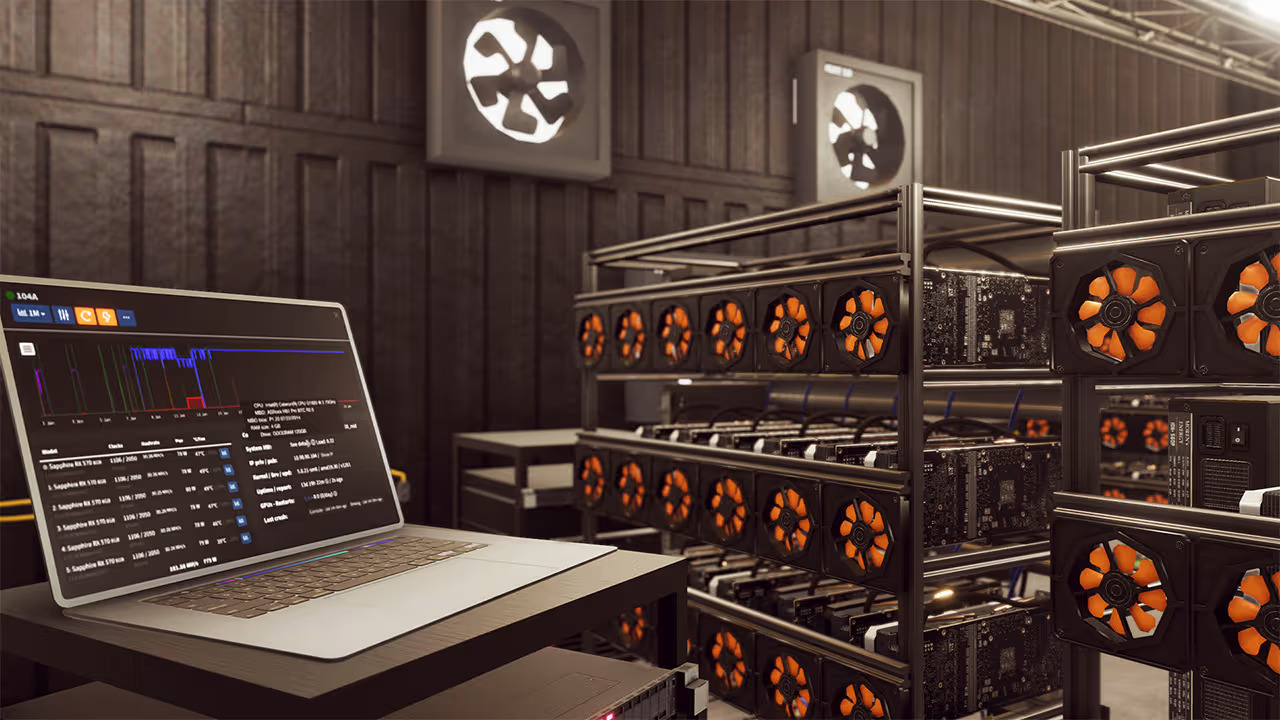
Modern cryptocurrency mining can require specialized hardware.
For major Proof of Work networks, professional mining operations often use ASICs, or application-specific integrated circuits.
These machines are designed to perform particular mining calculations efficiently.
Depending on the blockchain, miners may also use other types of hardware, but the equipment required varies significantly between networks.
Mining is no longer as simple as installing software on an ordinary laptop and expecting meaningful results.
Why Does Mining Require So Much Electricity?
Mining computers perform enormous numbers of calculations.
The more computational work a network requires, the more electricity mining equipment can consume.
This has led to significant discussion about the environmental impact of Proof of Work blockchains.
Energy consumption depends on factors such as:
- Mining hardware efficiency
- Electricity prices
- Network difficulty
- Mining activity
- Energy sources
The debate around Bitcoin mining is therefore more complicated than simply measuring how much electricity the network uses.
What Is Mining Difficulty?
Mining difficulty determines how difficult it is for miners to find a valid solution.
Blockchain protocols can adjust difficulty based on their design to help maintain a relatively consistent block-production schedule.
When more computational power joins a network, difficulty can increase.
When computational power decreases, difficulty can adjust in the opposite direction.
This mechanism helps the network remain stable as mining participation changes.
What Are Mining Rewards?
Mining rewards provide an economic incentive for miners to participate.
Depending on the blockchain, rewards can include:
- Newly issued cryptocurrency
- Transaction fees
- Other protocol-defined incentives
Bitcoin, for example, has a block subsidy that changes according to its protocol's scheduled halving events.
As a result, the economics of mining can change over time.
What Is a Bitcoin Halving?
A Bitcoin halving is a programmed event that reduces the amount of new Bitcoin included in the block subsidy.
The event occurs after a specific number of blocks have been mined.
Halvings are an important part of Bitcoin's monetary design because they gradually reduce the rate at which new Bitcoin is introduced through mining.
If you're learning about cryptocurrency economics, understanding concepts such as supply, scarcity, and halving events can provide useful context.
Is Crypto Mining Profitable?
Mining profitability is not guaranteed.
A mining operation's economics depend on several variables, including:
- Cryptocurrency price
- Electricity costs
- Hardware costs
- Mining difficulty
- Equipment efficiency
- Maintenance expenses
- Pool fees
- Block rewards
This means that receiving mining rewards doesn't automatically mean a miner is profitable.
Someone can earn cryptocurrency from mining while still losing money after accounting for electricity, hardware, and other operating costs.
What Is a Mining Pool?
Mining pools allow multiple miners to combine their computing resources.
Instead of competing entirely independently, participants work together to improve their chances of successfully mining a block.
When the pool earns a reward, it is distributed among participating miners according to the pool's rules and their contribution.
Mining pools have become an important part of the modern mining ecosystem.
Crypto Mining vs. Staking
Mining and staking are both associated with blockchain consensus, but they work very differently.
Mining
Mining is primarily associated with Proof of Work.
It relies on computational work and specialized hardware.
Staking
Staking is associated with Proof of Stake.
Instead of competing through computational power, participants commit cryptocurrency to support network validation.
You can learn more about staking in our guide What Is Crypto Staking?.

Can Anyone Start Mining Cryptocurrency?
Technically, participation depends on the blockchain and its requirements.
However, whether mining makes practical or financial sense is a different question.
Before buying mining equipment, beginners should consider:
- Hardware costs
- Electricity prices
- Expected operating expenses
- Network difficulty
- Mining rewards
- Hardware lifespan
- Local regulations
It's important to research the economics carefully rather than assuming that mining automatically generates income.
Common Misunderstandings About Crypto Mining
Mining Does Not Mean Creating Cryptocurrency From Nothing
New cryptocurrency can be issued as part of a blockchain's protocol, but miners don't simply create unlimited coins whenever they want.
The network determines the rules governing issuance.
Mining Is Not the Same as Trading
Mining involves contributing computational resources to a blockchain network.
Trading involves buying and selling digital assets.
They are completely different activities.
More Mining Equipment Doesn't Always Mean More Profit
Additional hardware can increase computational power, but it also increases electricity consumption and operating costs.
Profitability depends on the relationship between rewards and expenses.
Why Mining Matters to Blockchain
Mining is more than a way to earn cryptocurrency.
For Proof of Work networks, it is part of the security model that helps prevent fraudulent transactions and protects the blockchain from attacks.
It also creates an economic system in which miners are rewarded for contributing resources to the network.
Understanding mining therefore helps explain why decentralized cryptocurrencies can operate without a traditional central authority.
The Future of Crypto Mining
The mining industry continues to evolve.
More efficient hardware, changing energy markets, renewable energy projects, regulatory developments, and changes in blockchain economics are all influencing the industry.
At the same time, some blockchain networks are moving toward Proof of Stake and other consensus mechanisms that do not rely on traditional mining.
This means that understanding both mining and staking is useful for anyone who wants a broader understanding of blockchain technology.
Final Thoughts
Crypto mining is one of the fundamental concepts behind Proof of Work blockchains.
Miners use computational resources to help verify transactions, secure networks, and add new blocks to the blockchain. In exchange, they may receive rewards determined by the network's rules.
However, mining is a complex industry with significant costs and risks. It isn't simply a matter of purchasing a computer and generating cryptocurrency.
The best place to start is with education.
Once you understand Proof of Work, mining, blockchain security, and cryptocurrency economics, many other parts of the crypto ecosystem become much easier to understand.
Continue Learning With OurTeamClub
At OurTeamClub, we believe that understanding technology is the first step toward making informed decisions.
Our educational content covers blockchain, cryptocurrency, Web3, decentralized finance, financial literacy, and emerging digital technologies in a simple and accessible way.
If you're continuing to build your knowledge, explore our Earn With Us section and discover more about the OurTeamClub ecosystem.
Learn first. Explore responsibly. Build your knowledge for the digital future.
Recent posts
- What Is a Crypto Bridge? A Beginner’s Guide to Cross-Chain Transfers
- What Are Layer 1 and Layer 2 Blockchains? A Beginner’s Guide
- What Is a Blockchain Explorer? A Beginner’s Guide to Tracking Crypto Transactions
- Crypto Coins vs. Tokens: What Is the Difference?
- What Is a Blockchain Node? A Beginner’s Guide to Nodes and Network Validation