
- 17 Oct 2026
- 231 Views
- 8 minutes read
What Are Layer 1 and Layer 2 Blockchains? A Beginner’s Guide
Blockchain technology continues to evolve as more people and businesses explore cryptocurrency, decentralized applications, and Web3 services. As blockchain networks become more popular, they face an important challenge: how to process more transactions efficiently while maintaining security and decentralization.
This is where Layer 1 and Layer 2 blockchains come into play. These two approaches help blockchain ecosystems handle transactions, support applications, and improve network performance.
Understanding the difference between them can help beginners make sense of how blockchain technology works and why different networks are designed in different ways.
What Is a Layer 1 Blockchain?
A Layer 1 blockchain is the main blockchain network responsible for processing transactions, maintaining its ledger, and establishing the rules used to validate activity on the network.
Layer 1 networks operate using their own consensus mechanisms and security infrastructure. They do not depend on another blockchain to serve as their primary settlement layer.
Popular examples include Bitcoin, Ethereum, and Solana. Each network has its own architecture, transaction-processing methods, and approach to balancing security, decentralization, and scalability.
Layer 1 blockchains provide the foundation for many cryptocurrency and Web3 applications. They can support digital payments, smart contracts, decentralized finance, and other blockchain-based services.
However, when network activity increases significantly, some Layer 1 blockchains may experience slower transaction processing or higher fees. These limitations have encouraged developers to explore ways to improve scalability.
What Is a Layer 2 Blockchain?
A Layer 2 solution is a technology built on top of an existing Layer 1 blockchain to improve transaction capacity, reduce costs, or make applications more efficient.
Instead of requiring every operation to be processed directly on the main network, Layer 2 systems use additional mechanisms to handle some of the work separately. Depending on their design, they may process transactions off the main chain and submit transaction data or proofs back to Layer 1.
This approach can help reduce congestion while benefiting from the underlying blockchain's security model. The exact security properties depend on the specific Layer 2 architecture and implementation.
Examples associated with Ethereum include Arbitrum, Optimism, and Base.
Layer 2 solutions are particularly important for applications that need to process frequent transactions, including decentralized exchanges, blockchain games, and other Web3 platforms.

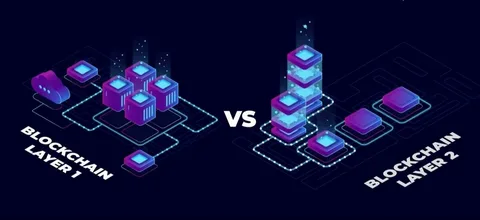
Layer 1 vs. Layer 2: What Is the Difference?
The main difference is where and how transactions are processed.
Layer 1 is the underlying blockchain. It maintains the core network rules, validates transactions, and provides the foundation for security and settlement.
Layer 2 builds on that foundation to improve how transactions are handled. It aims to increase capacity or reduce costs without requiring every transaction to be processed directly on the main chain.
For example, imagine a busy city with one main road. As traffic increases, the road becomes congested. Building additional routes can help distribute traffic and improve movement throughout the city.
In this comparison, Layer 1 is the main road, while Layer 2 represents additional routes that help manage traffic. The analogy is simplified, but it illustrates why both layers can be useful.
Neither layer is automatically better in every situation. The right choice depends on the application, its security requirements, transaction costs, and the network's technical design.
Why Does Blockchain Need Layer 2 Solutions?
Scalability is one of the most important challenges in blockchain development. As more people use a network, it must handle growing demand without compromising the qualities that make blockchain technology valuable.
Layer 2 solutions address several important needs.
Lower Transaction Costs
Blockchain transaction fees can increase when demand exceeds available network capacity. Layer 2 solutions can make certain transactions less expensive by processing them more efficiently.
Lower costs can make blockchain applications more practical for everyday activities, although fees vary by network, application, and market conditions.
Faster Transaction Processing
Some Layer 2 systems can process transactions more quickly than relying exclusively on the underlying Layer 1 network.
This can improve the user experience for activities such as transferring digital assets, interacting with decentralized applications, or trading tokens.
Actual performance depends on the solution's architecture, network conditions, and transaction type.
Greater Capacity
Layer 2 technologies can help blockchain ecosystems accommodate more activity without requiring the base layer to process every operation individually.
This can support the growth of Web3 services and applications that need to handle a large number of interactions.
Support for Web3 Innovation
Lower costs and improved transaction capacity can make it easier for developers to build applications that are accessible to a wider audience.
Layer 2 solutions can support experimentation across decentralized finance, gaming, digital identity, tokenized assets, and other blockchain-based services.
Common Types of Layer 2 Solutions
Not all Layer 2 technologies work in the same way. Their methods of processing transactions and interacting with the underlying blockchain can differ significantly.
Rollups
Rollups execute transactions outside the main Ethereum chain and submit transaction data or proofs to Ethereum, depending on their design.
Two widely discussed categories are optimistic rollups and zero-knowledge rollups.
Optimistic rollups generally assume submitted transactions are valid unless challenged through a dispute mechanism during a defined period.
Zero-knowledge rollups use cryptographic validity proofs to demonstrate that transactions follow the relevant rules.
Both approaches aim to increase transaction capacity, but they differ in verification methods, withdrawal processes, and technical trade-offs.
State Channels
State channels allow participants to conduct multiple interactions outside the main blockchain while using the blockchain to establish or settle the relevant state.
This can reduce the number of transactions that need to be recorded directly on the base layer. However, state channels are suitable only for certain use cases and require participants to follow the system's operational rules.
Sidechains and Other Scaling Networks
Sidechains are separate blockchain networks that can connect to another blockchain through a bridge or other interoperability mechanism.
They are sometimes discussed alongside Layer 2 technologies because they can help scale blockchain activity. However, a sidechain is not necessarily a true Layer 2 solution: it typically has its own consensus mechanism and security assumptions.
Understanding this distinction is important when comparing blockchain networks.
How Layer 1 and Layer 2 Work Together
Layer 1 and Layer 2 are often designed to complement each other rather than compete.
The Layer 1 network provides the underlying infrastructure for transaction settlement and security. A Layer 2 solution handles certain operations more efficiently and relies on the base layer according to its design.
For example, a user might transfer digital assets through an Ethereum-based Layer 2 network. The transaction may be processed on that network, while relevant data or proofs are submitted to Ethereum.
This arrangement can reduce the amount of work performed directly on the base layer while preserving important connections to its security infrastructure.
However, users should not assume that every Layer 2 network offers identical security guarantees. They should review how the network handles transaction data, withdrawals, upgrades, and potential failures.
Risks and Limitations to Understand
Although Layer 2 solutions can improve blockchain performance, they also introduce considerations that users should understand before interacting with them.
Security differences: Layer 2 systems have different designs and trust assumptions. Their security depends on factors such as proof systems, data availability, smart contracts, and administrative controls.
Bridge risks: Moving assets between networks may require a bridge. Bridges can introduce additional risks, including software vulnerabilities and operational failures.
Network compatibility: Not every token or decentralized application is available on every network. Users should verify that the destination network supports the asset or service they intend to use.
Withdrawal delays: Some systems may require waiting periods when transferring assets back to the underlying blockchain. The timing depends on the network and transfer method.
Changing fees: Layer 2 transactions are not always free. Users may pay network fees, bridge fees, or application-specific charges.
Understanding these limitations can help users evaluate blockchain services more carefully and avoid mistakes when moving digital assets.
How to Choose Between Layer 1 and Layer 2
The best option depends on what you want to accomplish.
If you are transferring assets, compare transaction costs, confirmation times, supported networks, and the security considerations associated with each route.
If you are using a decentralized application, check which networks it supports and whether the experience differs between them.
If you are researching a blockchain project, examine its technical documentation, security model, transaction activity, and development progress rather than relying only on promotional claims.
Beginners should also confirm the destination network before sending cryptocurrency. Sending assets through an unsupported network or to an incompatible address can result in lost funds.
The Future of Layer 1 and Layer 2 Technology
Blockchain infrastructure is continuing to develop as networks explore new approaches to scalability, interoperability, and user experience.
Layer 1 developers work on improving the underlying network, while Layer 2 developers create systems that expand transaction capacity and support new applications.
In the future, users may interact with multiple blockchain networks without needing to understand every technical detail behind each transaction. Improvements in wallet design, interoperability, and network infrastructure could make these experiences more accessible.
Nevertheless, blockchain ecosystems will continue to face challenges involving security, decentralization, regulation, and compatibility. Technical progress does not eliminate these risks.
For users and businesses exploring Web3, understanding the relationship between Layer 1 and Layer 2 provides a useful foundation for evaluating blockchain products and services.
Final Thoughts
Layer 1 and Layer 2 blockchains serve different but complementary purposes. Layer 1 provides the underlying network infrastructure, while Layer 2 solutions aim to increase transaction capacity and improve efficiency.
Together, these technologies help blockchain ecosystems support a wider range of applications and users. However, their performance, fees, and security characteristics vary, making it important to research each network before using it.
At OurTeamClub, learning about blockchain infrastructure is part of developing a clearer understanding of the digital asset and Web3 landscape. The more you understand how these systems work, the better equipped you are to evaluate emerging technologies and make informed decisions.
Recent posts
- What Is a Crypto Bridge? A Beginner’s Guide to Cross-Chain Transfers
- What Is a Blockchain Explorer? A Beginner’s Guide to Tracking Crypto Transactions
- Crypto Coins vs. Tokens: What Is the Difference?
- What Is a Blockchain Node? A Beginner’s Guide to Nodes and Network Validation
- What Is Crypto Market Cap? A Beginner’s Guide to Cryptocurrency Valuation